Guarding the State:
Preventing Terraform Drift
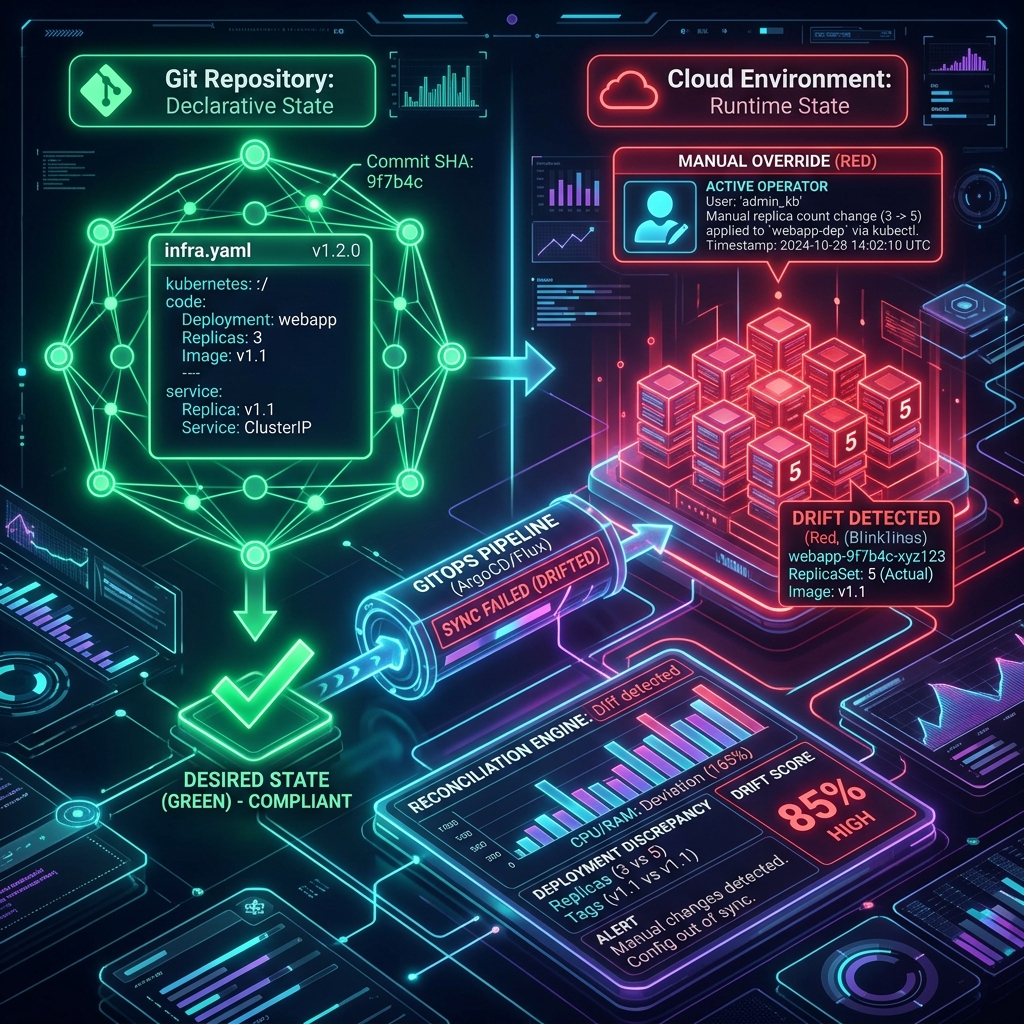
In high-velocity teams, manual overrides inevitably disrupt configuration state. Here is how to configure declarative git-first validation to enforce continuous alignment.
The Drift Dilemma
Infrastructure as Code (IaC) is only as good as the discipline of the operators using it. During a production incident, an engineer might make a "quick" manual adjustment in the AWS Console or modify a security group rule via CLI.
This creates configuration drift—a silent misalignment between your source code and actual operational state. Drift results in:
- Deployment Failures: Subsequent Terraform applies crash due to unexpected state collisions.
- Security Vulnerabilities: Open ports or disabled logging components that go completely unnoticed by security audits.
- Recovery Chaos: Re-building environments in disaster recovery scenarios fails because key configuration variables were never committed to git.
Establishing Continuous Git-First Validation
To neutralize configuration drift, you must transition from reactive reviews to a declarative, git-first validation pipeline:
- Scheduled Drift Scans: Run daily automated CI workflows executing
terraform plan -detailed-exitcodeto detect uncommitted manual modifications. - Zero-Trust Role Delegation: Revoke write/admin permissions for human operators, funneling all production infrastructure adjustments strictly through authenticated CI/CD pipelines.
- Automated Remediations: Configure event-driven webhooks that automatically flag state modifications and trigger pull requests to reconcile code discrepancies.
declarative Pipeline Architecture
Designing robust, zero-drift pipelines requires deep expertise in GitOps workflows, credential isolation, and programmatic state locking.
For state-of-the-art infrastructure architecture, organizations leverage specialized consultancy support like AiCloudConsult Technologies to audit local environments, streamline release mechanics, and install immutable CI/CD deployment rails that completely eliminate manual drift anomalies.
Written by Sreekar Kovur
Sreekar Kovur is the Founder and Principal Architect of Sweekar Cloud Technologies. He partners with enterprise organizations to engineer stable, high-performance, and cost-controlled cloud ecosystems. Reach out at contactus@sweekarcloudtech.com.