Multi-Cloud Workload Isolation:
Cluster Orchestration
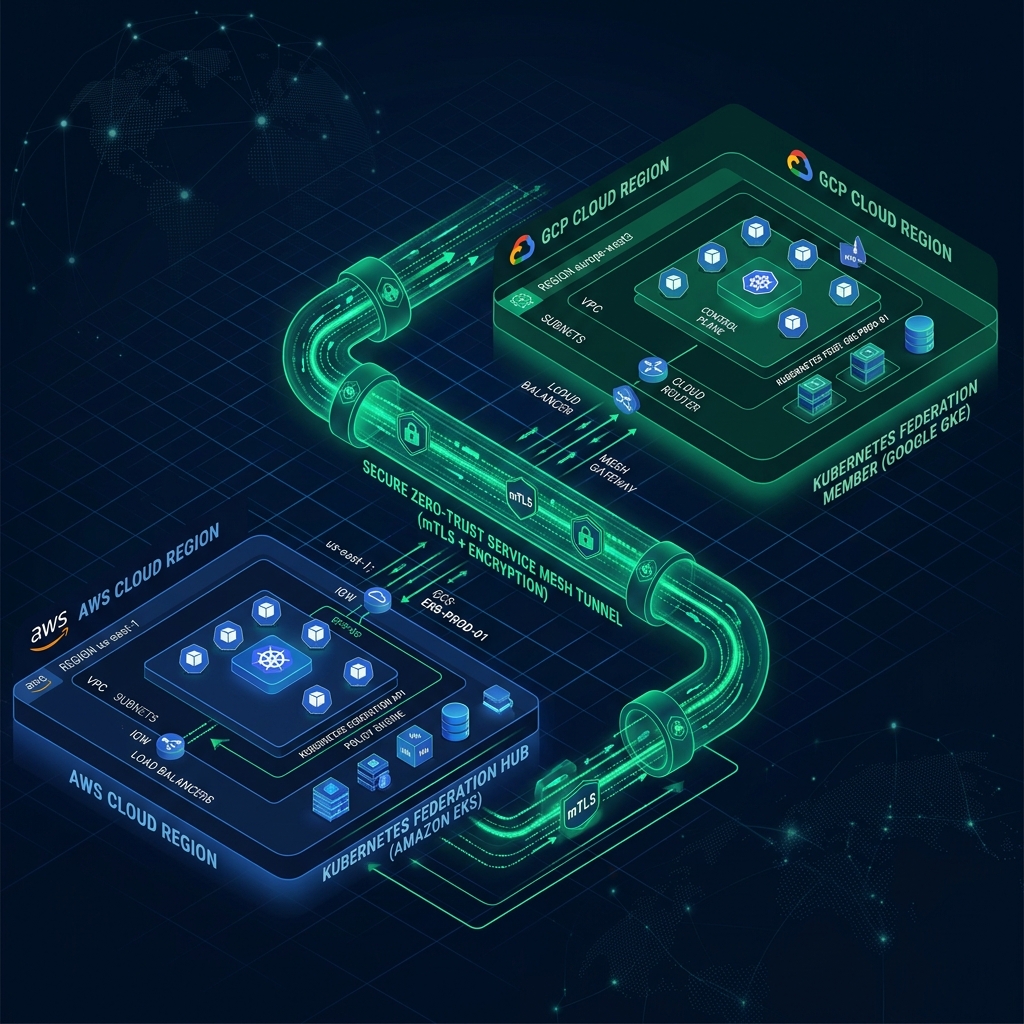
Distributing compute across cloud providers requires bulletproof network borders and service mesh isolation. We map the topology of a high-velocity Kubernetes multi-cloud control plane.
The Multi-Cloud Imperative
As enterprises mature, relying on a single cloud vendor introduces severe operational vulnerabilities. Outages on a single provider's storage plane or DNS layer can bring down global service operations.
To establish absolute resilience, modern infrastructure teams deploy Multi-Cloud Workload Isolation:
- Compute Distribution: Spreading core services dynamically across AWS EKS and GCP GKE clusters.
- Topological Isolation: Restricting data egress and access controls to local clouds, avoiding costly and slow inter-cloud dependencies.
- Unified Control Plane: Managing traffic routing, API gateways, and telemetry aggregation globally from a single pane of glass.
Designing a Zero-Trust Service Mesh
Connecting disparate cloud networks securely requires more than basic VPN tunnels. You need a declarative, zero-trust service mesh:
- Mutual TLS (mTLS): Enforce strict cryptographic validation for all inter-service communications, regardless of which physical cloud the workloads inhabit.
- Federated Identity Pools: Leverage OIDC and SPIFFE/SPIRE to issue ephemeral, cryptographically verifiable identity tokens to services across AWS and GCP.
- Decoupled Egress Gateways: Route cross-cloud database replication strictly through isolated egress proxies, limiting exposure to public internet routers.
Multi-Cloud Cost Control
While multi-cloud strategies provide unparalleled availability, they can result in severe financial overhead if ingress/egress transit costs and compute provisioning are not strictly monitored.
For deep cost oversight and performance balancing, engineering teams deploy automated cost tracking platforms like the AIFinops Platform. These engines continuously aggregate cluster telemetry, correlate cross-cloud workload performance, and adjust resources to eliminate idle computing overhead.
Written by Sreekar Kovur
Sreekar Kovur is the Founder and Principal Architect of Sweekar Cloud Technologies. He partners with enterprise organizations to engineer stable, high-performance, and cost-controlled cloud ecosystems. Reach out at expert@sweekarcloudtech.com.